
The Core Architecture of an AI Agent: LLM, Tools, and Memory
In our introduction to AI Agents, we defined them as autonomous systems that can reason, plan, and act. But how do they actually work on a technical level? What does the code and data flow look like inside an agent’s ‘mind’?
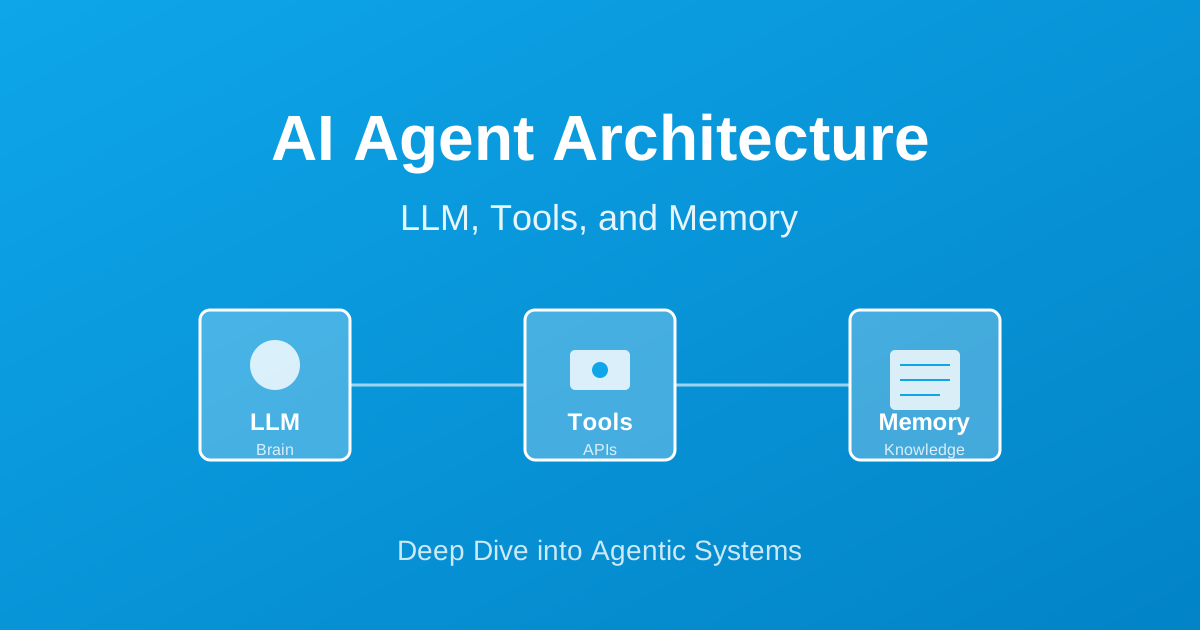
This guide provides a deeper architectural look at the three pillars of any modern AI Agent: the Large Language Model (LLM) brain, the Tools it uses to interact with the world, and the Memory system that allows it to learn.
The Agentic Engine: A High-Level View
At its heart, an AI Agent is an event loop orchestrated by an LLM. This loop takes a high-level goal and repeatedly makes decisions and takes actions until the goal is complete. This is often called an agentic loop or a ReAct (Reason + Act) framework.
Here’s a diagram of the core data flow:
graph TD
    A[User Goal] --> B{LLM Brain};
    B -- 1. Reason & Plan --> C[Select Tool];
    C -- 2. Act --> D[Execute Tool (e.g., SERP API)];
    D -- 3. Observe --> E[Get Tool Output];
    E --> B;
    B -- 4. Analyze & Repeat --> F{Goal Complete?};
    F -- No --> C;
    F -- Yes --> G[Final Answer];
Let’s break down each component in this architecture.
1. The Brain: The LLM’s Role as a Reasoning Engine
The LLM is not just a text generator; in an agent, it’s a dynamic reasoning engine. Its primary job is to function as a planner. When you give an agent a goal, the LLM receives a carefully crafted master prompt that might look something like this:
You are a helpful research assistant. Your goal is to: {user_goal}.

You have access to the following tools:
- `search(query)`: Searches the web for real-time information. Use this for current events or general knowledge.
- `scrape(url)`: Reads the content of a specific webpage.

Based on your previous actions and observations, decide on your next action. Your final answer should be a summary of your findings.

Previous Actions: {history}

Your Thought:
I need to find out X. To do this, I will use the `search` tool.

Your Action:
{ "tool": "search", "query": "X" }
With every iteration of the loop, the LLM fills in the “Your Thought” and “Your Action” sections. The agent’s framework then parses this output and calls the corresponding tool.
2. The Tools: Grounding the LLM in Reality
Tools are the most critical part of making an agent useful. They connect the LLM’s abstract reasoning to concrete, real-world data and actions.
The SERP API: The Agent’s Eyes on the World
An LLM’s knowledge is frozen at the time of its training. A SERP API is the single most effective tool to overcome this limitation.
- Architectural Role: It’s a function call (e.g.,
search(query)) that the agent can invoke. The function takes a string query, makes a request to a service like the SERPpost API, and returns a structured JSON object of search results. - Why it’s Essential: It grounds the agent in the present. For tasks involving recent news, market trends, or competitor analysis, access to real-time search results is non-negotiable.
The URL Extraction / Scraper API: The Agent’s Hands
After the SERP API returns a list of promising URLs, the agent needs to be able to “read” those pages. This is where a URL extraction or scraping tool comes in.
- Architectural Role: It’s another function (e.g.,
scrape(url)) that takes a URL, fetches its content, cleans the HTML, and returns the raw text or structured data. - Why it’s Essential: It allows the agent to go beyond search result snippets and consume the full content of a source. This is the foundation of DeepResearch and enables the agent to synthesize information from multiple pages.
💡 Pro Tip: For robust agents, it’s better to use a dedicated URL extraction API rather than building your own
requestsandBeautifulSouplogic. A third-party API can handle JavaScript rendering, proxies, and retries, making your agent far more reliable.
3. The Memory: Enabling Learning and Context
Memory allows an agent to maintain context and learn over time. Without it, every task would start from a blank slate.
Short-Term Memory: The Conversation History
This is the simplest form of memory. The history or scratchpad in the agentic loop stores the sequence of (Action, Observation) pairs from the current session. This history is included in the prompt sent to the LLM in every iteration, giving it the full context of what it has already tried.
- Limitation: This context window is finite. For very long tasks, the history can become too large to fit in the LLM’s prompt.
Long-Term Memory: The Vector Database
For true learning, agents need a long-term memory. This is typically implemented using a vector database (e.g., Pinecone, Chroma).
- How it Works:
- Storage: When the agent discovers a valuable piece of information (e.g., from scraping a URL), it uses an embedding model to convert this text into a vector (a list of numbers).
- Retrieval: When starting a new task, the agent first embeds the user’s goal and queries the vector database to find the most similar (i.e., relevant) pieces of information it has stored from past tasks.
- Augmentation: This retrieved information is then added to the LLM’s prompt, giving it a head start. This process is known as Retrieval-Augmented Generation (RAG).
Conclusion
The architecture of an AI Agent is a powerful combination of a reasoning engine (LLM), real-world interfaces (Tools), and a system for retaining knowledge (Memory). It’s this synergy that allows an agent to move beyond simple Q&A and tackle complex, multi-step goals autonomously.
As you begin to build your own agents, remember that the quality of their tools, especially their access to real-time web data via a SERP API, will be the single biggest determinant of their performance.
Ready to build your first agent? Get your tools ready.
Start our Python & LangChain tutorial → (Coming Soon)