
DeepResearch vs. Traditional Scraping: A Technical Comparison
When it comes to gathering data from the web, ‘web scraping’ is the term most people know. However, not all scraping methodologies are created equal. The approach you choose can dramatically impact the quality, completeness, and strategic value of the data you collect.
In this guide, we’ll provide a detailed technical comparison between two distinct approaches: Traditional Web Scraping and DeepResearch. Understanding their architectural and operational differences is key to building a truly effective web intelligence system.
At a Glance: Key Differences
Let’s start with a high-level comparison table:
| Feature | Traditional Scraping | DeepResearch |
|---|---|---|
| Data Discovery | Manual; limited to known URLs | Automated; discovers new URLs via SERP |
| Data Completeness | Shallow; data from a fixed set of pages | Deep; builds a comprehensive, interconnected dataset |
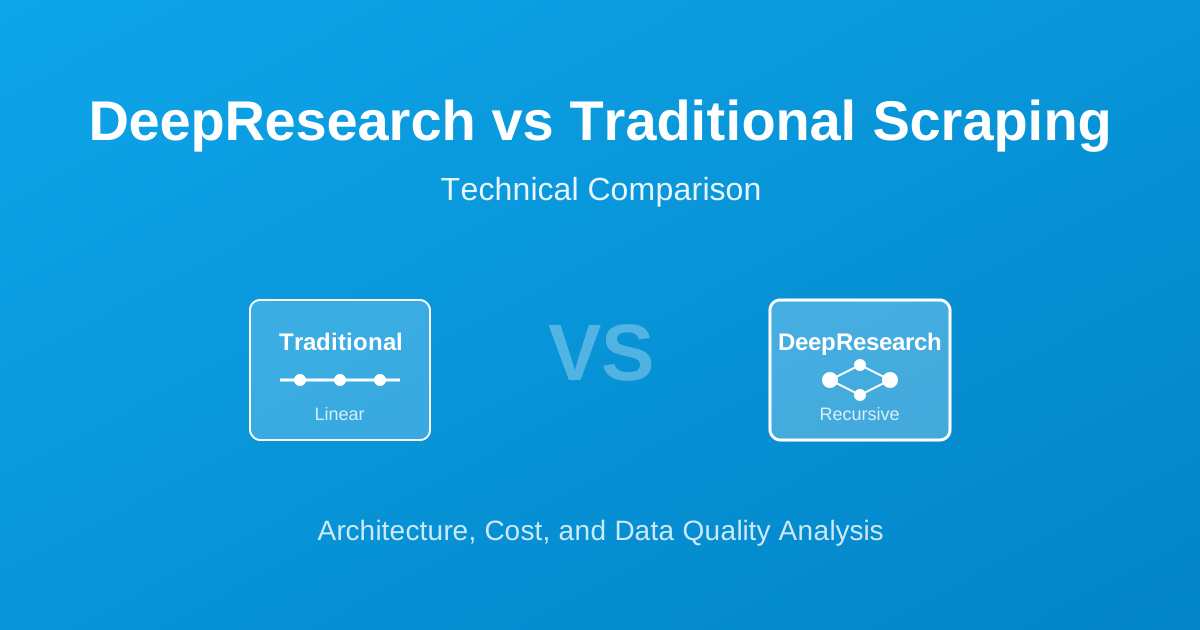
| Architecture | Linear (URL List → Scraper) | Recursive (Query → Discover → Scrape) |
| Scalability | Difficult to scale discovery | Highly scalable via queueing systems |
| Data Freshness | Stale; relies on pre-existing URL lists | High; starts from real-time search results |
| Setup Complexity | Simple for small, fixed tasks | More complex, but built for scale |
Architectural Breakdown
The most fundamental difference lies in their architecture and data flow.
Traditional Scraping: A Linear Path
The architecture is straightforward and linear. You begin with a list of URLs and feed them to a scraper.
Flow: [Known URL List] -> [Scraper] -> [Structured Data]
This model is effective for targeted, repetitive tasks where the scope is well-defined and static. For example, scraping the price of a specific product from a single Amazon page every hour.
- Pros: Simple to set up for small tasks.
- Cons: Incapable of discovering new information. The scope is rigid and requires manual updates.
DeepResearch: A Recursive Cycle
DeepResearch operates on a cyclical, discovery-oriented model. It doesn’t start with a list of URLs, but with a concept—a search query.
Flow: [Query] -> [SERP API] -> [URL Queue] -> [Scraper & Discoverer] -> [Data & New URLs for Queue]
This recursive loop allows the system to autonomously explore a topic, branching out from the most relevant pages first and digging deeper into the information network. It builds its own scraping list as it goes.
- Pros: Excellent for discovery and comprehensive analysis. Highly scalable.
- Cons: More complex initial setup involving a SERP API and a queueing system.
Detailed Comparison
Let’s dive deeper into the key areas of differentiation.
1. Data Discovery & Completeness
- Traditional Scraping: You only get data from the pages you explicitly tell it to scrape. If your competitor launches a new, unlinked landing page, you won’t know about it until you discover it manually.
- DeepResearch: Its primary strength is discovery. By starting with a SERP query (e.g., your competitor’s brand name), it will immediately find that new landing page as soon as it gets indexed by Google. This leads to a far more complete and timely dataset.
2. Scalability and Maintenance
- Traditional Scraping: Scaling means manually finding more URLs to add to your list. The maintenance burden grows linearly with the scope. The logic is often brittle and tied to the structure of specific pages.
- DeepResearch: Scaling is an inherent part of the architecture. To broaden the scope, you simply add more seed queries. The system handles the discovery and crawling of thousands or millions of resulting pages automatically via its queue. Maintenance focuses on the crawler’s resilience, not on manually curating URL lists.
3. Cost and Efficiency
- Traditional Scraping: The initial cost seems low—you ‘just’ need a scraper. However, the hidden costs are in the manual labor required for research and discovery, and the infrastructure needed to manage proxies and avoid blocks at scale.
- DeepResearch: There is an upfront cost for a reliable SERP API. However, this cost is offset by the complete automation of the discovery process, saving countless hours of manual research. It’s a shift from a labor-intensive process to a more efficient, API-driven one.
💡 Cost Analysis: A junior researcher might spend 10 hours a week finding new pages to scrape. At $25/hour, that’s $1,000/month in labor. A high-volume SERP API plan that automates this entirely can often be more cost-effective.
Which Approach Should You Choose?
Your choice depends on your project’s goals.
Choose Traditional Scraping if:
- You have a small, fixed list of URLs that rarely changes.
- Your data needs are simple and targeted (e.g., tracking one price on one page).
- The project is a one-off task with a limited scope.
Choose DeepResearch if:
- You need to discover new information and data sources automatically.
- You are conducting market research, competitive analysis, or lead generation.
- You need a comprehensive, up-to-date view of a topic or industry.
- The project is long-term and needs to scale over time.
Conclusion
While traditional web scraping has its place for simple, targeted tasks, DeepResearch is the superior methodology for building strategic data assets. It transforms data collection from a static, manual chore into a dynamic, automated intelligence-gathering operation.
By investing in a DeepResearch architecture, you are not just scraping data; you are building a system that can autonomously map out and understand your entire digital landscape.
Ready to make the leap to a more intelligent data collection strategy?
Explore the SERPpost API documentation → to see how you can power your DeepResearch engine.