
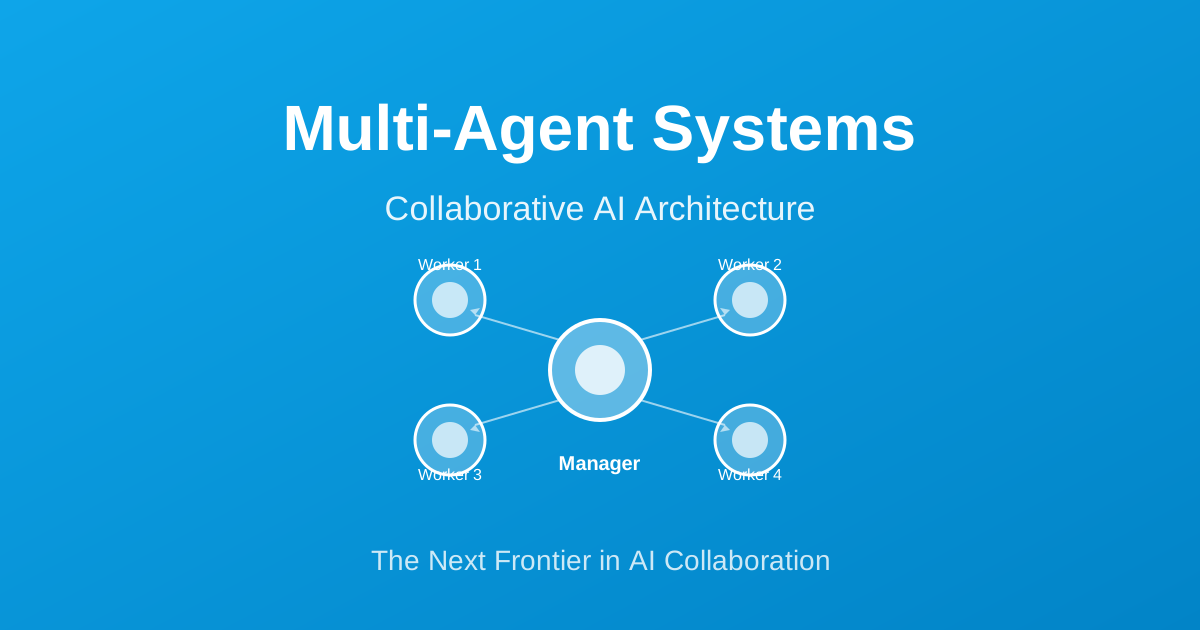
Introduction to Multi-Agent Systems: The Next Frontier in AI
We’ve seen how a single AI agent can automate complex tasks. But what happens when a task is too big, too complex, or requires too many different skills for one agent to handle? The answer lies in the next evolution of agentic AI: Multi-Agent Systems.
A Multi-Agent System is a framework where multiple autonomous agents interact with each other to achieve a common goal. Instead of building one monolithic, jack-of-all-trades agent, you create a team of specialists that can collaborate, delegate, and divide labor.
Why Do We Need More Than One Agent?
The principle is the same as in human organizations: specialization leads to efficiency and higher quality.
- Complexity Management: Breaking down a massive problem (e.g., “launch a new product”) into smaller, manageable sub-tasks (market research, content creation, social media campaign) is more effective.
- Skill Diversity: A single LLM prompt can struggle to be an expert in everything. You can have a ‘Creative Writer Agent’ and a ‘Data Analyst Agent’ that are fine-tuned or prompted for their specific skills.
- Parallelization: Multiple agents can work on different parts of a problem simultaneously, dramatically speeding up the overall process.
- Resilience: If one agent gets stuck, another can potentially take over or provide assistance.
Common Architectures for Multi-Agent Systems
There are several ways to orchestrate a team of agents. Two of the most common patterns are Hierarchical (Manager-Worker) and Collaborative (Round-Table).
1. Hierarchical (Manager-Worker) Model
This is the most straightforward approach, mimicking a traditional corporate structure.
- The Manager Agent: A top-level agent that is responsible for decomposing the main goal into sub-tasks and delegating them to specialized ‘worker’ agents.
- Worker Agents: Each worker agent is an expert in a specific domain. It receives a task from the manager, executes it using its own set of tools, and reports the result back.
Example: Automated Market Report Generation
graph TD
    A[User Goal: "Create a market report on AI in finance"] --> B(Manager Agent);
    B -- Task 1 --> C(Research Agent);
    C -- Uses SERP API & URL Extractor --> D[Raw Data];
    D --> B;
    B -- Task 2 (with Raw Data) --> E(Analysis Agent);
    E -- Analyzes data for trends --> F[Key Insights];
    F --> B;
    B -- Task 3 (with Key Insights) --> G(Writer Agent);
    G -- Writes a formatted report --> H[Final Report];
    H --> B;
    B --> I[Return Final Report to User];
In this model, the Research Agent is an expert in using tools like the SERPpost API to gather information. The Analysis Agent is skilled at identifying trends in data. The Writer Agent excels at generating well-structured, human-readable text.
2. Collaborative (Round-Table) Model
This model is less structured and more like a brainstorming session. All agents are peers and can communicate with each other in a shared environment, like a group chat.
- Shared Scratchpad: A common context window where each agent posts its thoughts and findings.
- Turn-Based Interaction: An orchestrator decides which agent should ‘speak’ or act next, based on the current state of the conversation.
This approach is excellent for complex problem-solving where the path forward is not clear, such as debugging code, scientific discovery, or creative brainstorming.
Key Components of a Multi-Agent Framework
Building a multi-agent system requires a few additional components on top of a single agent’s architecture:
- Agent Router/Dispatcher: This is the traffic cop. When a task comes in, it decides which agent is best suited to handle it.
- Shared State/Memory: A common database or context window where agents can share their findings and see the work of others.
- Inter-Agent Communication Protocol: A defined way for agents to send messages, delegate tasks, and report results to each other.
Frameworks like AutoGen from Microsoft and advanced features in LangChain are specifically designed to facilitate the creation of these systems.
The Role of Tools in Multi-Agent Systems
Tools become even more critical in a multi-agent environment. While some agents might have specialized tools (e.g., a ‘Code Execution Agent’), a core set of tools is often shared among all agents.
Access to real-time, accurate information is the bedrock of effective collaboration. A reliable SERP API and URL Extraction API serve as the shared ‘intelligence source’ for the entire system, ensuring that every agent, from the researcher to the analyst, is operating with the same ground truth from the live web.
Conclusion
Multi-Agent Systems represent a significant leap towards creating truly autonomous and highly capable AI. By moving from a single ‘super-agent’ to a team of collaborating specialists, we can tackle problems of a much greater scale and complexity.
This approach, which mirrors the effectiveness of specialized teams in human organizations, is the future of applied AI. As you scale your AI ambitions, think less about building a single, all-powerful agent and more about building a high-performing team.
Ready to see how AI agents can be applied in specific industries? Explore our FinTech use case → (Coming Soon)